How are aerial tramways built?
How are cable cars built on the mountain? Specifically how is the cable transported to the build site and how is it mounted onto the rails? Lets have a look at the answers to these questions in the following.
How aerial tramways actually work
To understand how they are built lets first have a look at the basic function of an aerial tramway. The cables of cable cars come in different variants. Usually a cable car has multiple cables with specific purposes. In the case of a "Aerial tramway" the tram is resting on the track cables via some rolls that are attached to the cabin. The haulage rope is pulling the cabin across these track cables.
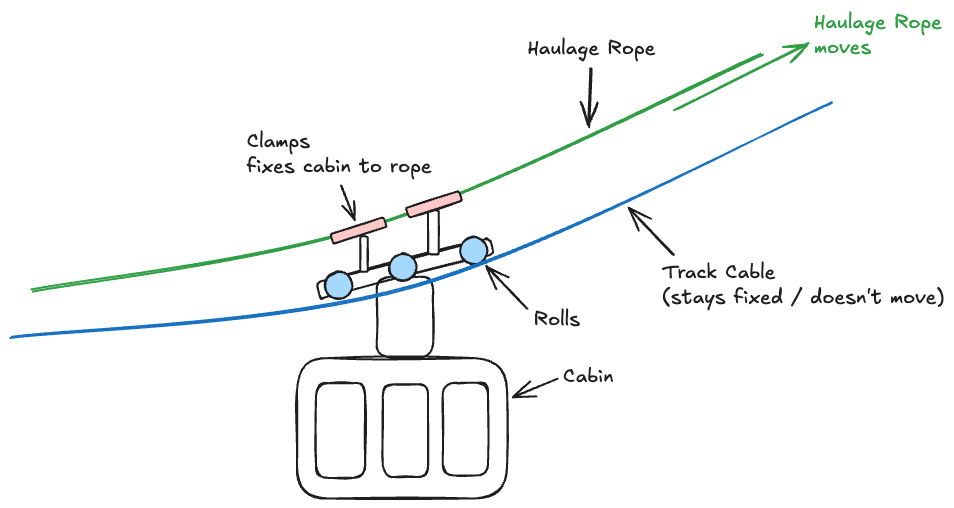 How Aerial Tramways work
So we end up with a situation where the track cable doesn't move at all and can be fixed to the stations at the top and bottom of the track. These cables are therefore not a continuous loop. The Haulage Rope on the other side moves with the cabin. Ideally you therefore want a continuous loop. The top view would look like this:
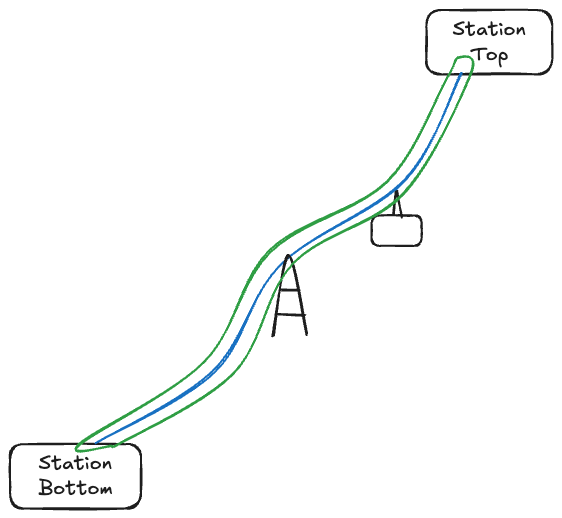
Aerial Tramways Cable Routes
Building the tramway
So when thinking about constructing such a tramway there are a few questions that come to mind:
- How long and heavy are these cables?
- How are the cables transported to the build site?
- How are the cables installed?
- How is that continuous loop of the haulage rope created?
To answer these questions we are going to look at the example of the new Säntis Bergbahn. Here the new haulage rope is 4900m long and weighs 33 tons. The track cables are 2600m long and weigh 53 tons each 12. The cable is manufactured by the company Fatzer AG in Romanshorn (at lake constance). These cables are transported to the build site using large hauling trucks but they are actually in a single piece and on a big spool.
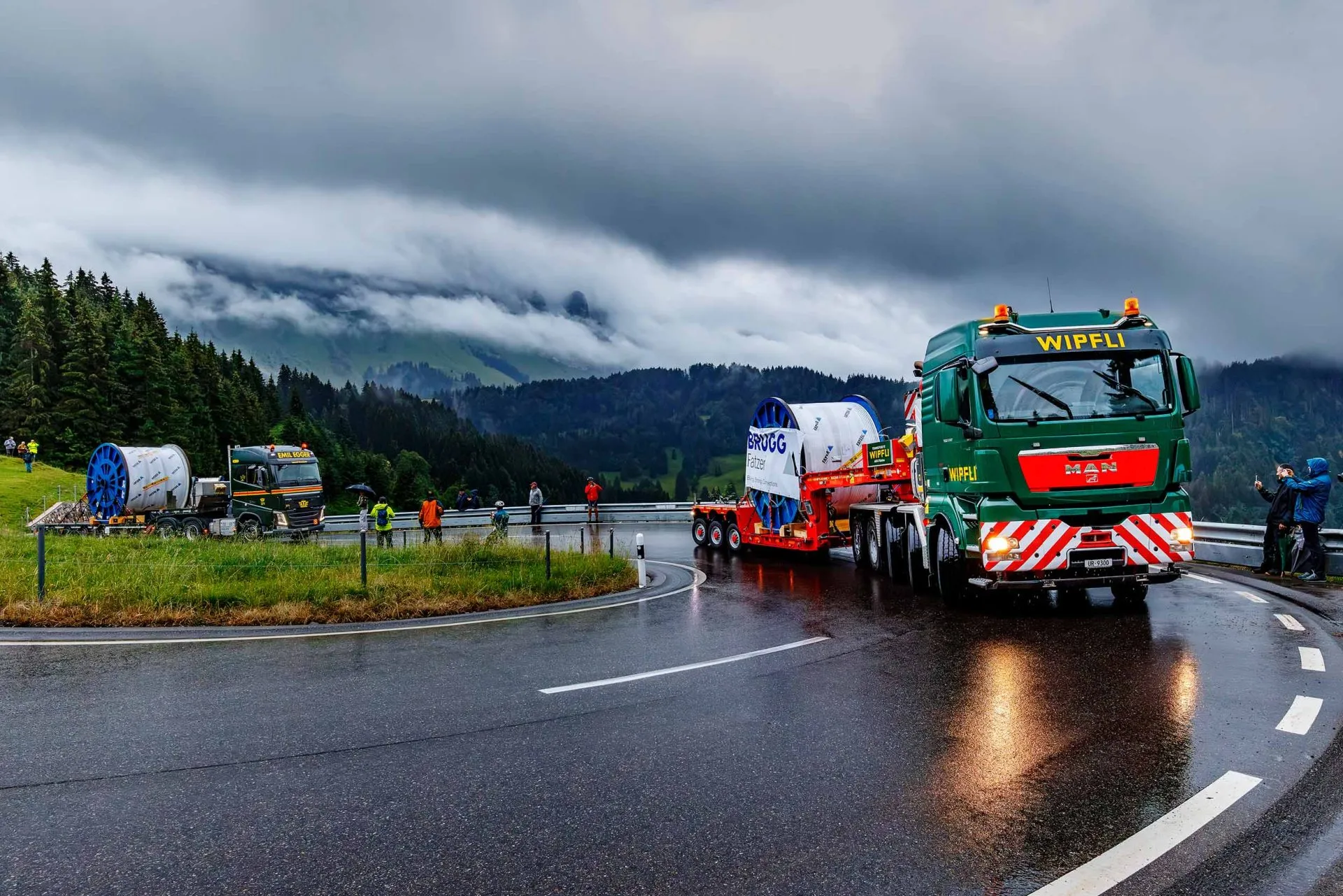 Cable transport - Source: 1
Interestingly when the first tramway was built here at Säntis in 1935 the cable already weighed 35t and had to be transported from Herisau in a 43 day journey.
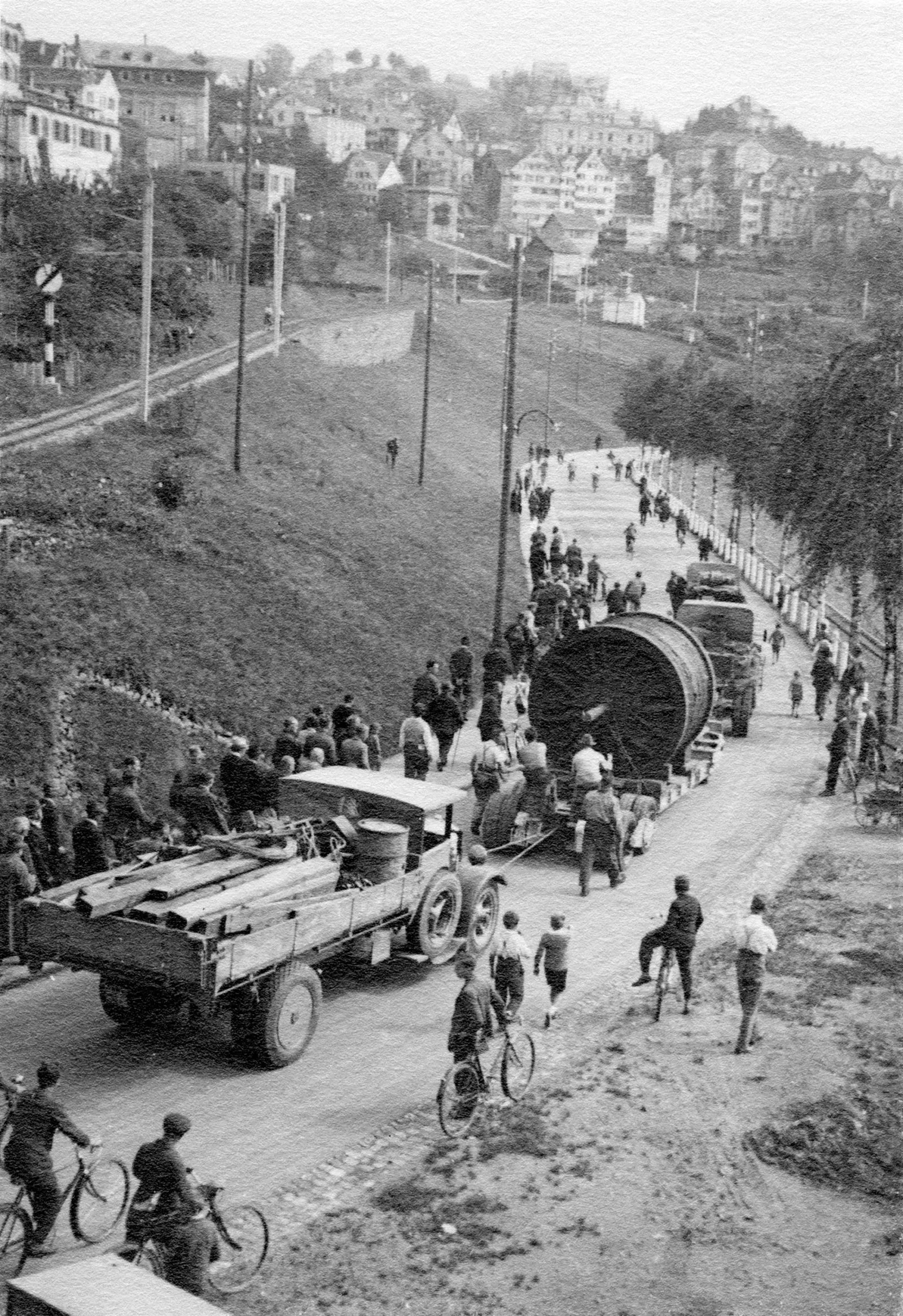 Cable transport 1935 - Source: 1
So yes the cables are produced in one piece and transported to the build site on one big spool. Once the cables are at the buildsite an initial lightweight rope is attached to a helicopter and pulled through the rolls of the stations and the posts. However in case of the new Säntisbahn they were able to reuse some of the old cables to pull through a new cable therefore reducing the need for another lightweight cable. Once that first cable is pulled through a slightly heavier and sturdier cable is pulled through. You do this with stronger and stronger cables until you are able to pull the heavy actual cables through. There is heavy machinery involved in actually pulling these cables through.
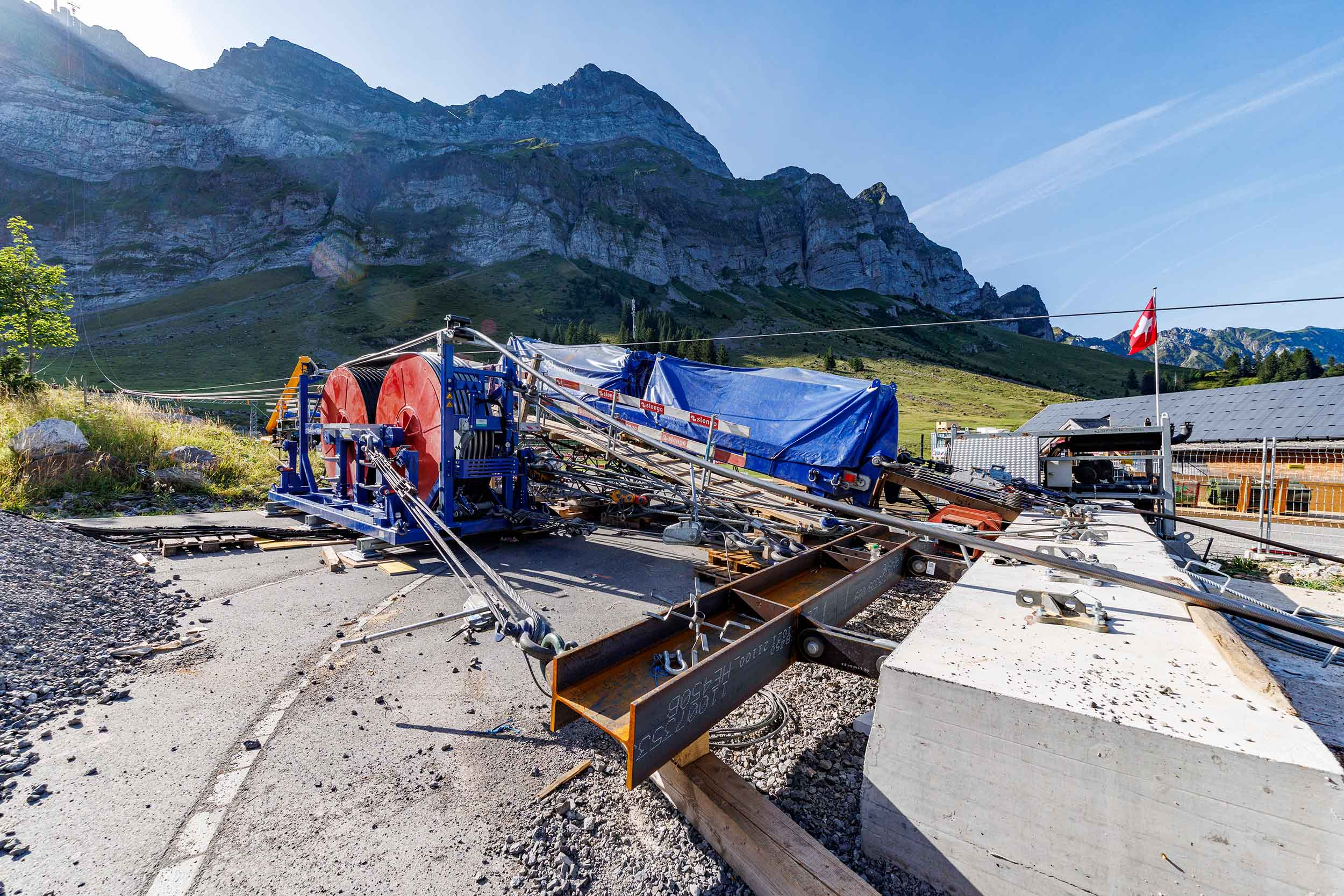 Cable machine - Source: 1
For the track cables you can then attach the ends of these cables in the top and the bottom station, tension the cable and thats basically it (except for some additional fancy maintenance mechanism where you have change the cable every ten years. They store some slack for that and pull that through when needed).
For the hauling rope you need one additional step though. You need get the ends of the rope and form a continuous loop. This process is called splicing. You basically untwine the individual strands of the ends of the rope and then intertwine them together. This is still a very manual process and involves some very niche experts. See 3 for an example of this process. Theres a lot of interesting things going on in this splice but just facts that stuck with me:
- The joint here only happens through friction. There is no welding going on but just intertwining of the cables. By having a long enough overlap area the friction is large enough so the cable never comes apart. So basically the rope is actually not a real loop but rather just two ends that hold together by friction. Scary.
- There is a lot of care taken so that this splicing area has exactly the same thickness as the rest of the cable. So theres lots of careful hammering involved to ensure that.
Summary
So yeah theres a lot of fascinating details around aerial tramways, their cables and the building process. If you want to know more about it I suggest reading the articles published by the Saentisbahn linked above. They did a great job documenting the building site.